For students who finish Class 12 with the ability to go further than the next available college seat, and who need twelve months to do it properly rather than in a panic.
Every year, thousands of students in India take a repeat year for entrance examinations. Most of them do the same thing they did before, alone, at greater cost and under more pressure, and most of them do not improve enough to justify it. That is the model this programme was built against.
The Thirteenth Year is a structured post-Class 12 year at CFAL combining core physics, chemistry and mathematics with research work, making, computing, and time with people who do these things for a living. Students sit JEE Main, KCET, BITSAT and Olympiads. They also apply, properly and on time, to universities abroad and to the scholarships without which those universities stay out of reach.
It is not a repeat year with extra classes attached. The examinations are part of the year; they are not what the year is for.
Application work in progress — laptop, deadlines, a mentor alongside.
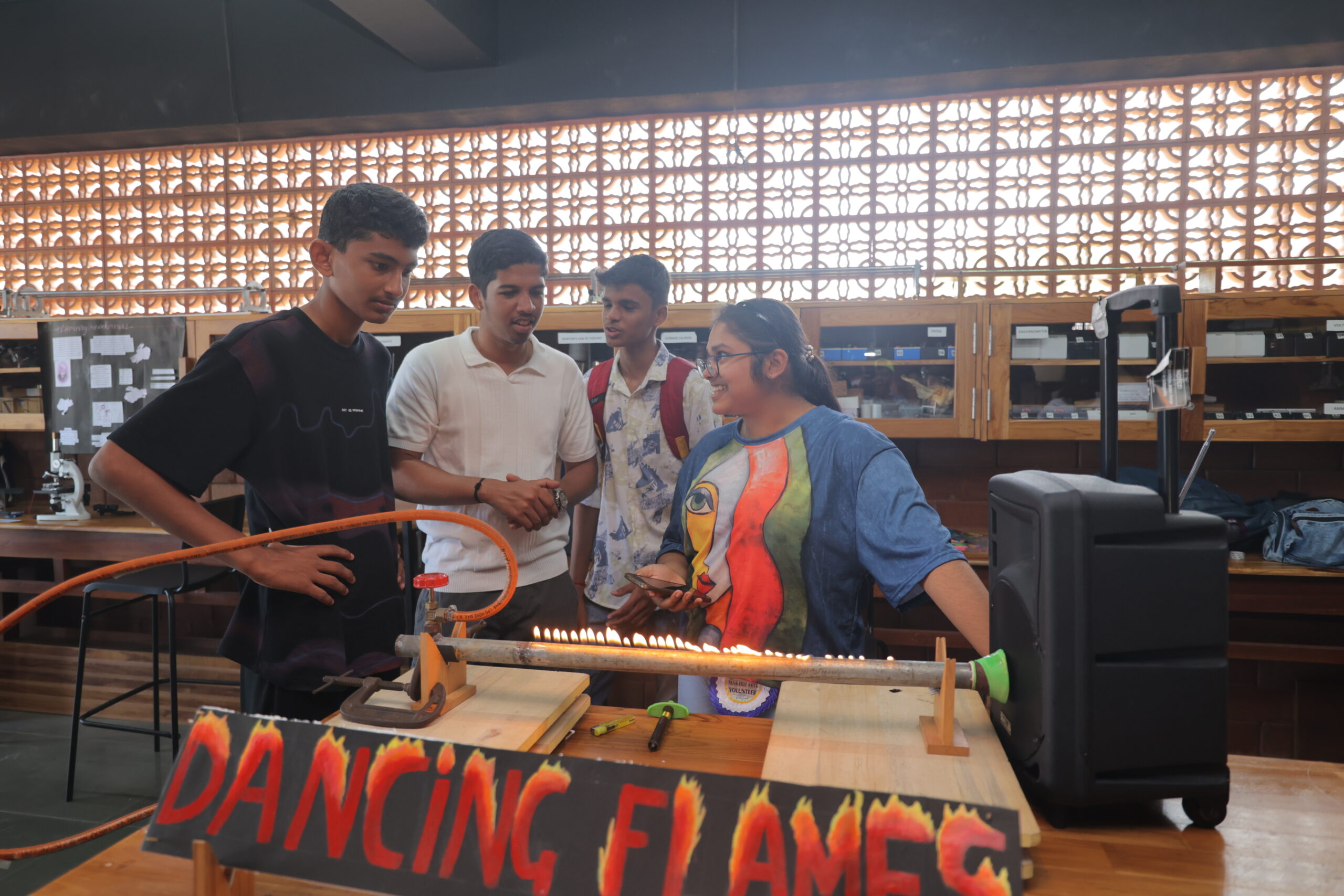
Focused problem work, with a teacher present rather than solitary.
A student in conversation with a working researcher or practitioner.
Applications to universities in the UK, Australia, Singapore and elsewhere cannot be done well alongside board examinations. This year gives them the months they need, and keeps the Indian entrance routes open at the same time.
A result that fell short of what the student is capable of, where another attempt is genuinely worth making — with teaching and structure around it, rather than a year alone with a question bank.
Eighteen is early to choose a life. A year spent in laboratories, in the makerspace, and in conversation with working researchers and practitioners tends to settle that question faster than another year of guessing.
It does not suit a student who wants only more hours of coaching. That exists elsewhere, and is cheaper.
Structured time is capped at roughly forty-two hours a week. The cap is set by the trustees and is not negotiable, including by ambitious parents and including by the students themselves.
The reason is simple. A year of eighty-hour weeks produces a tired student with a worse result, and we have watched that happen to other people's children often enough to design against it.
Indicative shape of a week. Core teaching happens in CFAL's regular senior batches, with placement reviewed at every unit test, so a student is never parked in a group below what they can do.
The coordinator with one student, one to one. Unglamorous and specific — this is the operational promise the page makes, so it should be shown actually happening.
The programme coordinator holds two separate weekly reviews: one for each student, and one for each stream. A student who is drifting is visible within a week rather than at the end of a term, which in a twelve-month programme is the difference between a correction and a write-off.
Broad exposure to practitioners comes first, through the year. Access to specialist institutions and named researchers follows around December, once a student knows enough to ask a good question — introducing them earlier tends to waste the introduction.
Core teaching begins. Project and makerspace work starts. Broad practitioner exposure, and the first honest conversations about which pathways are realistic.
International application windows open. The intent is to submit early and clear the desk, rather than arriving at January with everything still outstanding.
Specialist access begins. Expectations are narrowed deliberately: a student cannot chase every examination at once, and this is the point at which the list is cut to what the hours allow.
JEE Main, KCET, BITSAT and Olympiads, with applications already submitted rather than competing for the same weeks.
Support through JoSAA, KCET, COMEDK and BITS counselling, and for offers from abroad, through to a pre-departure briefing. The programme's responsibility ends when the student is settled somewhere, not when the results are out.
A drop year is unstructured, solitary and defined entirely by one examination. This year is timetabled, reviewed weekly, and built around several routes at once, so that a poor result in any one of them does not end the year.
The honest version of the argument is this: the alternative most families choose is joining a college nobody wanted, in order to avoid the appearance of losing twelve months. That costs four years, not one.
Then the student takes it, and we help them prepare to go. Nothing in this programme requires a student to stay for the sake of completing it.
It is a real possibility and we say so rather than promising around it. What a student carries out regardless is a year of laboratory and project work, sustained contact with working researchers, a clearer sense of what they want, and another set of entrance results. Whether that is worth a year is a judgement each family should make with the facts in front of them, and we would rather you made it carefully than optimistically.
Very few. The programme depends on individual weekly attention, and it stops working at scale.
This is a young programme running with a small first cohort. We are not going to show you outcome statistics, because we do not have any yet, and inventing them would be the fastest way to lose the trust this depends on.
What exists is the design: the hours ceiling, the weekly reviews, the practitioner access, the application calendar, and staff who have run senior science teaching here for years. Come and see it, talk to the coordinator, and decide from that.
To discuss whether this fits your child: office@cfalindia.com · +91 99005 20233.